

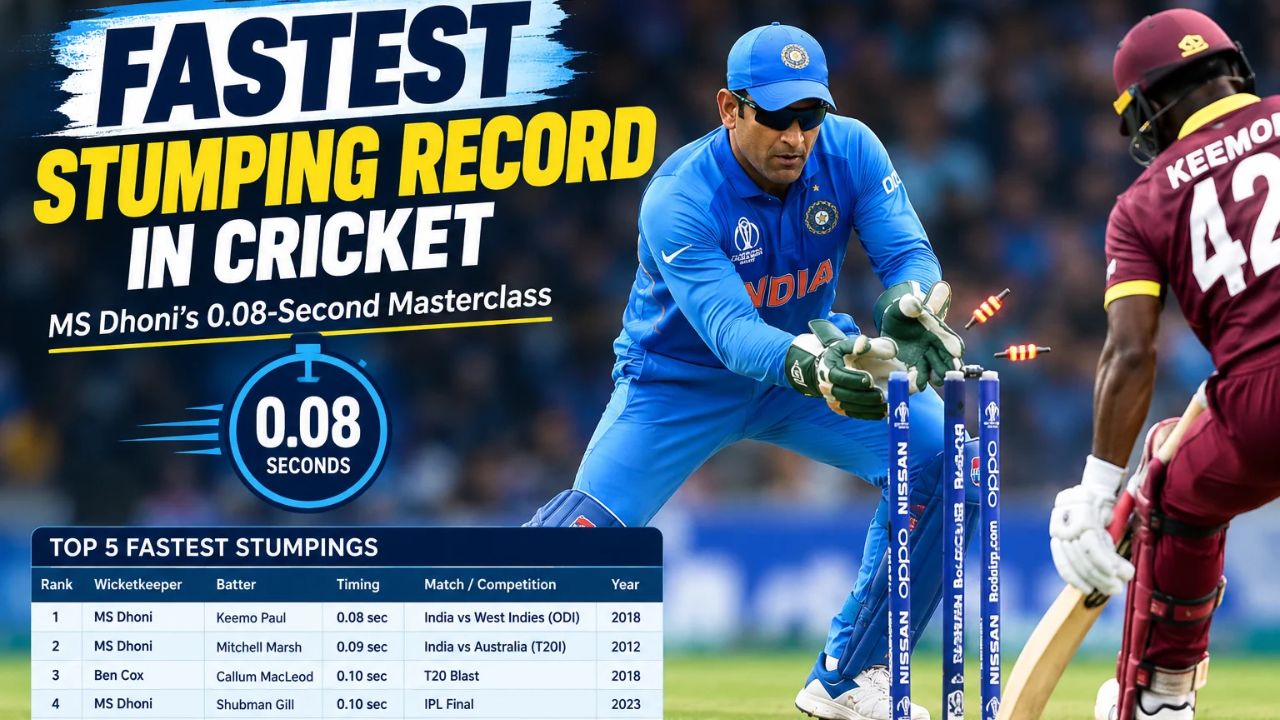
In cricket, the record for fastest stumping is most commonly associated with former Indian captain MS Dhoni. He has amazed cricket fans globally with his amazing wicket keeping abilities. During an ODI match in 2018, Dhoni dismissed West Indian batsman Keemo Paul in a reported time of only 0.08 seconds. This incredible display of Dhoni’s quick reflexes, focus, and ability to knock off the bails prior to a batsman returning to the crease was highly publicized.
The 0.08 second time frame has been used as a standard for estimating the fastest stumpings ever recorded. Cricket organizations do not officially keep a running total of the fastest stumpings.
Dhoni has become one of the most famous wicketkeepers in the history of the sport due to his fast hands and excellent wicketkeeping skills.
Who Holds the Fastest Stumping Record in Cricket?
MS Dhoni has been credited by many to have made the quickest stumping in cricket history when he dismissed Keemo Paul in October 2018. The incident took place during the fourth One Day International (ODI) game between India and the West Indies at the Brabourne Stadium in Mumbai.
West Indies were pursuing India’s score when Ravindra Jadeja bowled a spin-off delivery which defeated Keemo Paul’s effort to strike the ball. Paul moved forward, then for a short period of time, stepped out of his batting crease. Dhoni caught the ball cleanly and knocked down the stumps nearly immediately.
Jadeja was as surprised as the wicket keeper when he got out so fast. This incident has been covered by many cricket news organizations, who are reporting that Jadeja was dismissed in 0.08 seconds.
Dhoni’s performance showed how critical anticipation is to being a successful wicketkeeper and the necessity for accurate hand movement when catching. Dhoni did not simply react to the ball with quickness, but rather anticipated the batter’s movements and where the ball was likely to travel.
Fastest Stumping Record in Cricket: Top 5 Reported Timings
The following table presents some of the well-known stumpings associated with exceptionally quick wicketkeeping. These timings are reported estimates, not officially verified measurements.
| Rank | Wicketkeeper | Batter | Reported Timing | Match or Competition | Year |
| 1 | MS Dhoni | Keemo Paul | 0.08 seconds | India vs West Indies, ODI | 2018 |
| 2 | MS Dhoni | Mitchell Marsh | 0.09 seconds | India vs Australia, T20I | 2012 |
| 3 | Ben Cox | Callum MacLeod | 0.10 seconds | T20 Blast | 2018 |
| 4 | MS Dhoni | Shubman Gill | 0.10 seconds | IPL Final | 2023 |
| 5 | Brendon McCullum | Ricky Ponting | 0.11 seconds | Cricket World Cup | 2011 |
1. MS Dhoni’s 0.08-Second Stumping Against Keemo Paul
The manner in which Dhoni dismissed Keemois perhaps the best example of how fast a wicketkeeper can react to take a wicket in international cricket. This event occurred on October 29th, 2018 at the fourth One Day International (ODI) match played between India and the West Indies.
India posted an impressive total of 377-5. When the West Indies were batting, Ravindra Jadeja delivered a ball which spun away from Paul as he tried to hit it with both feet out of the crease.
Before Paul was able to get back into position, Dhoni was able to see where the ball would go, catch it, and then take off the bails. This resulted in Paul being given out for stumping, and this play became very popular with many cricket fans.
0.08 seconds has been cited as being indicative of the typical time taken by a wicket-keeper to perform his role. However, it should be noted that this is not an official, independently-standardised measurement.
The dismissal will always be remembered as an excellent example of Dhoni using his anticipatory skills, balanced stance, and extremely fast hand-eye coordination during times when he was under a great deal of pressure in matches.
2. MS Dhoni’s Stumping of Mitchell Marsh
During India’s 2012 T20 International Series with Australia, another prime illustration of how quickly Dhoni reacts to keep wicket was evident. After Mitchell Marsh advanced to hit a ball and missed it completely, Dhoni was able to quickly move up to stump him.
Marsh’s movement gave the wicket-keeper a chance. Dhoni fielded the ball and knocked down the stumps, prior to the batsman being able to get back into his crease.
Dismissals are frequently referenced to have occurred at approximately 0.09 seconds. This number has never been officially documented as a world record, but it provides context as to why Dhoni’s stumpings were such a common subject of conversation for many cricket fans.
In addition, his ability to stay steady behind the wicket was very useful when playing against spin bowlers. Spin bowlers make subtle changes to the way they throw the ball, the amount of turn it has, and how high it bounces. All of these factors can cause a batsman to step out of his crease.
3. Ben Cox’s Quick Stumping of Callum MacLeod
Ben Cox, an English wicketkeeper, was another wicketkeeper who produced very fast stumpings. He had a lot of interest in his play behind the stumps while playing in domestic cricket.
In the 2018 T20 Blast, Cox made a quick stumping of Callum MacLeod. That dismissal has been widely cited as an illustration of rapid reflex and efficient use of the gloves.
In addition to the previous incident, the time of 0.10 seconds has been linked to this event. Like the stumping time figures mentioned in other articles, this figure is believed to represent a reported estimate and not a officially certified record.
The event shows that great wicket keeping does not only occur in international cricket, but domestic competition has wicket keepers that are capable of responding quickly to the errors of batters.
4. MS Dhoni’s Stumping of Shubman Gill in the IPL Final
MS Dhoni made a second great stumping at the 2023 IPL Final with Chennai Super Kings vs. Gujarat Titans.
The first game of the series took place in Ahmedabad, India. In the initial portion of the game when Gujarat batted, Ravindra Jadeja delivered a ball to Shubman Gill, who stepped up to strike the ball.
Gill missed the ball, allowing Dhoni to catch it and knock off the bails prior to Gill being able to return to his position. This was a critical point during a highly stressful final.
Dhoni’s use of stumping has been reportedly timed at about 0.10 second. In addition, this demonstrated that even as he entered the latter years of his playing days, he was still able to contribute significantly in making decisions from behind the wickets.
He created opportunities that other wicket keepers would likely not see due to his knowledge of the art of spin bowling and how a batsman moves their feet.
5. Brendon McCullum’s Quick Stumping of Ricky Ponting
Brendon McCullum was also known as a fast wicket keeper with good reflexes. The stumping of Ricky Ponting of Australia by McCullum at the 2011 Cricket World Cup can be found in some lists of quick stumpings.
Approximately 0.11 seconds were recorded during this dismissal. Although there is no official time to compare against, this event demonstrates how important it is to make fast decisions and gather the ball properly.
In addition to being an aggressive batsman and excellent wicket-keeper, Brendon McCullum was also a very useful cricketer for New Zealand. Similar to MS Dhoni, he knew that a successful stumping is often based upon knowing what the batsman will do before the chance arises.
These attributes are vital for limited-overs cricket as batsmen often take steps forward to break a bowler’s rhythm or attack a spinner.
Why Is MS Dhoni Considered One of the Fastest Wicketkeepers?
The high-speed of some of his dismissals has contributed greatly to MS Dhoni being recognized as an outstanding wicketkeeper. However, it was also through his excellent technique, quick thinking and consistency that he became one of the greatest wicketkeepers to ever play in international cricket.
Exceptional Reflexes
When a batsman fails to hit the ball, or steps out of his crease, the wicket-keeper has to respond rapidly. MS Dhoni was very successful in catching balls that came down the wicket toward the stumps and then knocking the bails off with as little extra motion as possible.
Anticipation and Reading the Batter
Fast wicketkeeping isn’t just about how fast you move your hands. It is about being able to anticipate what the batsman will do next, knowing the variations of each of the bowlers on your team, and having the correct body position.
The Dhoni appeared to be prepared to take advantage of a stumping chance prior to the batsman finishing his forward movement.
Efficient Hand Movement
A clean collect is essential. If the ball bounces off the glove, or if the wicketkeeper has to change his/her grip on the ball, the batter may be able to make it back into the crease.
With his efficient movements, Dhoni was able to perform numerous complex stumpings in a short amount of time.
Experience Against Spin Bowling
Dhoni was able to use his time playing with India’s spin bowlers (i.e. Ravindra Jadeja and Ravichandran Ashwin) to develop a better understanding of how the batsmen would react to different types of bowling (i.e. flight, turn, and pace).
This knowledge was particularly hazardous for a batter who had moved closer to the pitcher to hit the ball but missed it.
Is the Fastest Stumping Record Official?
The 0.08 second stumping has been referenced many times, but there is no officially recognized world record for this type of event.
Although many media sources have reported when Dhoni completed the stumping of Keemo Paul, there is no official record maintained by Cricket’s Governing Authorities that ranks players according to how quickly they perform every stumping.
The time taken for an out to occur is reported by TV graphics, replay analysis and media reports using different methods. This is why the same event can have varying times when reported on various websites.
In other words, while the media has been able to claim that Dhoni’s dismissal of Keemo Paul is the fastest stumping ever based upon the time reported for the action (0.08 seconds), no official certification of this fact exists.
But Dhoni still holds an established international wicketkeeping record; that is, he has made 195 stumpings in international cricket – the most of all wicketkeepers. This is a career statistic and is separate from the “unofficial” times.
What Is a Stumping in Cricket?
A “stumping” occurs when the wicket-keeper legally breaks the wicket when a batsman is out of his/her crease and has no protection against being dismissed for running.
When a batsman attempts to hit a spin bowler’s delivery by running forward on the pitch, and misses it completely, the batsman may be dismissed as being “stumped.” To do so, the wicketkeeper must first catch the missed ball and then break the stumps with it before the batsman has returned to his/her position.
A stumping differs from a run-out in that it is executed solely by the wicket-keeper (under the specified conditions). On the other hand, a run-out may be achieved by another member of the fielding team and typically occurs when a batsman is running towards one end of the pitch.
The wicket-keeper must comply with all applicable Laws of Cricket, particularly those that govern the delivery and the position of the batsman. Although a stumping cannot be made when the bowler has delivered a “no ball,” there are still several methods by which the batsman can be dismissed.
Conclusion
The rapid stumping of Keemo Paul by MS Dhoni in 2018 is generally considered to be the quickest ever. It was reported that the act took only 0.08 seconds, and this is still one of the best examples of how quickly a wicket keeper can react.
Other names, such as Ben Cox and Brendon McCullum have been mentioned as having extremely fast stumpings; however, it must be noted that any timing associated with those events is an estimate and not an official ranking.
Dhoni has left a lasting impression on the game of cricket that is much greater than just a single quick dismissal. He was recognized as one of the best wicketkeepers to ever play the game with his 195 international stumpings, exceptional anticipation skills and performance under extreme pressure. One of the most memorable examples of his skill, preparation and precision changing the course of a match in an instant was his famous stumping of Keemo Paul.
Read Also: 6 Ball 6 Sixes Record List International Cricket || Chris Gayle Highest Score in IPL || What Is the Highest Score in IPL by a Player
Frequently Asked Questions
Who holds the fastest stumping record in cricket?
MS Dhoni is widely associated with the fastest stumping in cricket history. His dismissal of Keemo Paul against the West Indies in 2018 was reported to have taken 0.08 seconds. However, this timing is not an officially standardized world record.
How many seconds did MS Dhoni take to stump Keemo Paul?
The dismissal is widely reported as taking 0.08 seconds. The figure is based on media and broadcast reporting rather than an official timing system maintained by cricket authorities.
Who was dismissed in MS Dhoni’s fastest reported stumping?
West Indies batter Keemo Paul was the batter dismissed by Dhoni during the fourth ODI between India and the West Indies in Mumbai on October 29, 2018.
Is 0.08 seconds the official world record for the fastest stumping?
No official, standardized fastest-stumping record is maintained by cricket’s governing authorities. The 0.08-second figure is a widely reported estimate associated with Dhoni’s dismissal of Keemo Paul.
Who has the most stumpings in international cricket?
MS Dhoni holds the record for the most stumpings in international cricket, with 195. This career total is an established statistical record and is different from claims about the fastest individual stumping.














Leave a Reply