

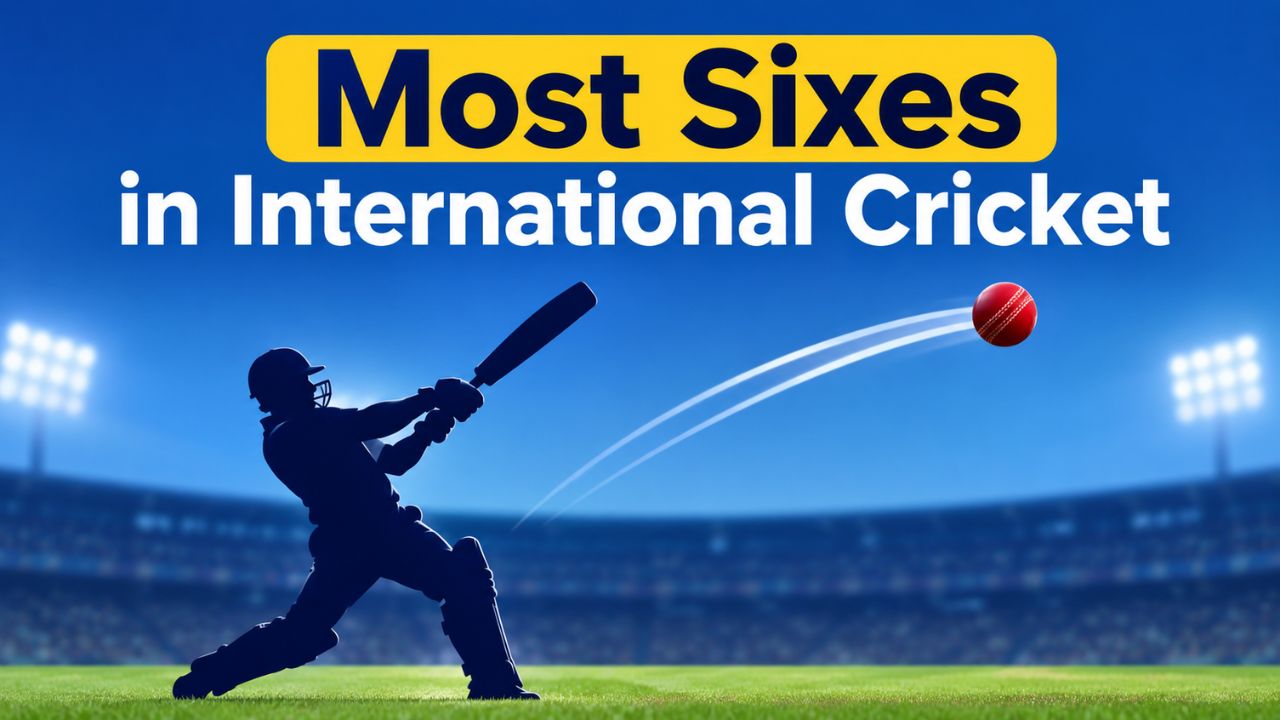
One of the most exhilarating sights in cricket is a ball disappearing over the boundary high into the stands. Most sixes do turn a match on her head in seconds but some sixes are famous just because of the distance where they went.
A single name has been the answer for cricket fans searching far and wide to learn who hit the Longest Six in Cricket History: Shahid Afridi It is also told that his 153-metre six against South Africa in Johannesburg in 2013, remains the most widely reported. But the truth is that cricket has no official record book for six distance – figures of celebrated distances, not all are accepted measures.
Instead of treating each number as an officially confirmed record, this piece examines some popular reported big sixes and what we really know about them.
Longest Six in Cricket History – Shahid Afridi
The name of Shahid Afridi has been synonymous with gigantic sixes throughout his playing career. Afridi hit an enormous six during Pakistan’s ODI against South Africa at Johannesburg in 2013, which is often recorded as being 153 metres.
It has been replicated by countless cricket publications and websites making it easily the most quoted answer to that question regarding the longest six in world cricket.
Nonetheless, the measurement of 153 metres should be considered in a similar vein to the reported figure, as opposed to an official world record. An earlier study by Kristofor et al. reconstructed the shortening game and identified precisely how far off we were, highlighting considerable uncertainty surrounding some of these historical six-distance measures (including Afridi’s).
Top 10 Widely Reported Longest Sixes
| Player | Opponent | Year | Reported Distance |
| Shahid Afridi | South Africa | 2013 | 153 m* |
| Brett Lee | West Indies | 2005 | 130–143 m* |
| Jacob Oram | Australia | 2006 | 130 m* |
| Tim David | India | 2025 | 129 m* |
| Martin Guptill | South Africa | 2012 | 127 m* |
| Liam Livingstone | Pakistan | 2021 | 122 m |
| Corey Anderson | India | 2014 | 122 m |
| Mark Waugh | New Zealand | 1997 | 120 m |
| Yuvraj Singh | Australia | 2007 | 119 m |
| MS Dhoni | New Zealand | 2009 | 118 m |
* Reported figures can vary between sources and should not be considered universally certified measurements.
Brett Lee’s Massive Six
Brett Lee was mostly known for being one of the fastest bowlers in history but the Australian pacer could hit a very long ball too.
His mammoth six against the West Indies at the Gabba in 2005 is often included among cricket’s biggest hits. This distance has been announced to be flight 130 or the areas around it depending on inside data. The variation itself shows the caution surrounding historical six-distance lists.
The reason Lee’s shot is especially memorable, however, was that it was struck by a player who had fasted for ten hours on the day of the match and one less known as having big-hitting prowess than bowling speed.
Martin Guptill’s 127-Metre Six
Martin Guptill is another name quite often thrown into the discussion of biggest sixes eater
The 127 meter heaving against South Africa at Wellington in 2012 is often given as a reference. This six has a fuller measurement story than many other older claims. Replays of the shot suggested that had it not hit a stadium structure, the ball would have travelled at least another 30 to 40 metres after its initial journey of more than around from bat to stand was between fifty and sixty.
So Guptill’s six is a fascinating case in point example of why straight comparisons between figures from yesteryear and today can be inherently misleading.
Tim David’s 129-Metre Six
Another name has been inscribed on the rolls of modern cricket.
Tim David hit a so-called 129-metre six off Axar Patel during Australia’s T20I against India in Hobart in November 2025. The ball smashed into signage above the David Boon Stand, and was estimated by Fox Cricket’s statisticians to have travelled 129 metres had it not hit the structure.
It’s significant because as contemporary reports described the hit, that was at the time a record length six in men’s T20 internationals. In the same innings, David scored 74 from just 38 balls.
However, this is a crucial distinction: just because it was the record for T20 internationals doesn’t mean that that’s also an official record of any six across all forms of cricket.
Liam Livingstone – 122 Metres
Another of today’s great modern power hitters, England’s Liam Livingstone is a six-hitting machine.
His six against Pakistan in 2021 – is often recorded at a distance of 122 metres. Livingstone’s power-hitting ability, combined with his propensity to clear long boundaries easily has landed him a spot on many contemporary lists of the biggest sixes.
Corey Anderson – 122 Metres
Corey Anderson from New Zealand also appears at the top of these historical lists.
Anderson’s six against India in 2014: 122 metres Like a number of other claims on these lists, the figure is a frequently cited but not sourced to some definitive international roping database for measuring every six.
Yuvraj Singh’s 119-Metre Six
There are many spectacular innings of Yuvraj Singh that have stuck around, be it his six sixes in an over against Stuart Broad during the lays in 2007 T20 World Cup.
However,when it comes to distance (and not number of sixes) another Yuvraj hit inevitably works its way right into the conversation: an enormous 119m six against Australia in 2007.
Because he was blessed with a very powerful swing, terrific timing and early hand action, the ball could travel some great distances even without being hit all out by him.
MS Dhoni’s 118-Metre Six
Shahid Afridi – known for his explosive hitting style as well as MS Dhoni’s favourite helicopter shot and finishing skills aimed; these two players were amongst cricket’s most recognisable power hitters.
A six you smashed New Zealand back in 2009 is often featured at around the 118 metres mark. One of the hallmarks of the way he generated record levels of power, especially at the back end of innings, was his strength through the bottom hand.
Is Shahid Afridi’s 153-Metre Six Official?
This is where it gets a little more complex.
Several articles have dubbed Afridi’s 153-metre hit as the longest ever six in cricket history. But cricket does not have an official governing-body-recognized database that keeps tabs on the longest six by distance. Some of the most well-known distances from history have now been scrutinized by more recent analyses.
Thus, here is the most economical way to describe Afridi’s hit:
Shahid Afridi’s 153-metre six is something of a myth as far as distance goes, with the exact measurement debated, and it does not figure in an officially accredited Guinness world record.
Better worded than the blunt statement that 153 metres is undoubtedly an official record,
Why Are Six-Distance Records Difficult to Verify?
There are several reasons.
The first thing is that cricket grounds have a different shape. Having the ball hit the roof and advertising board and stand or any other structure during its unbroken flight.
Second, older matches were played the days before modern ball-tracking and stadium tracking systems.
Third, some reported ranges are predictions. With a player like Guptill, the combined distance of how far the ball actually traveled and its estimated additional trajectory is still calculated to reach the reported number.
Lastly, various sites have quoted different figures for the same shot. The footnote for Afridi’s mighty hit, for instance, has come up as 153m; 158m and even 160m in different accounts.
Biggest Sixes: Reported vs Measurement
| Category | Example | What We Know |
| Widely reported longest | Afridi – 153 m | Famous claim, exact measurement disputed |
| Modern T20I record claim | Tim David – 129 m | Contemporary broadcast calculation |
| Detailed tracking example | Guptill – 127 m | Based partly on projected distance |
| Historical huge hit | Brett Lee – 130–143 m | Different figures reported |
| Older sixes | Mark Waugh and others | Measurements are difficult to independently verify |
What About Albert Trott?
One such name and particularly intriguing is the one associated with Albert Trott.
According to reports, Trott smashed a huge six on the Lord’s ground in 1899. Others have noted that some modern articles have called it possibly the longest shot ever played.
At the time, though, tracking technology was much more basic. Therefore, the distance can not be determined with the same confidence as a tracked shot today.
To accurately depict Trott’s shot, it is much more effective to characterize it as a celebrated six at that particular distance than it is to provide an exact modern measurement.
Longest Six in Different Cricket Formats
| Format | Famous Long Six | Reported Distance |
| International cricket overall | Shahid Afridi | 153 m* |
| Test cricket | Brett Lee | 130–143 m* |
| ODI cricket | Shahid Afridi | 153 m* |
| T20 International | Tim David | 129 m* |
| T20 cricket | Several modern power hitters | Varies |
The asterisk matters because these figures are not all measured using the same technology or methodology.
Read More: Most Runs in ODI World Cup || Oldest Cricket Stadium in the World
Final Thoughts
The much-wondered six, thought to have been struck 153 metres by Shahid Afridi against South Africa in 2013 is mostly widely regarded as the longest six ever hit in cricket. That said, if accuracy is the goal that number should not be considered an official record and presented as such.
Then you have Brett Lee, Martin Guptill, Liam Livingstone, Corey Anderson and Yuvraj Singh and MS Dhoni hitting huge sixes while Tim David’s apparent 129-metre hit in 2025 became one of the most iconic modern T20I moments.
The larger lesson is that comparing six-distance records is an unexpectedly tricky business. The numbers are affected by older measurements, distances that have been projected, stadium structures and inconsistent reporting. Hence, the better articles do not name every multiple of a number as an official figure, but differentiate between numbers that do get reported broadly and numbers that can be independently verified.
In addition, if you are looking for information about “Longest Six in Cricket History”. A commonly cited answer is Shahid Afridi – 153 metres, with the critical caveat that this distance cannot be determined definitively.




Leave a Reply