

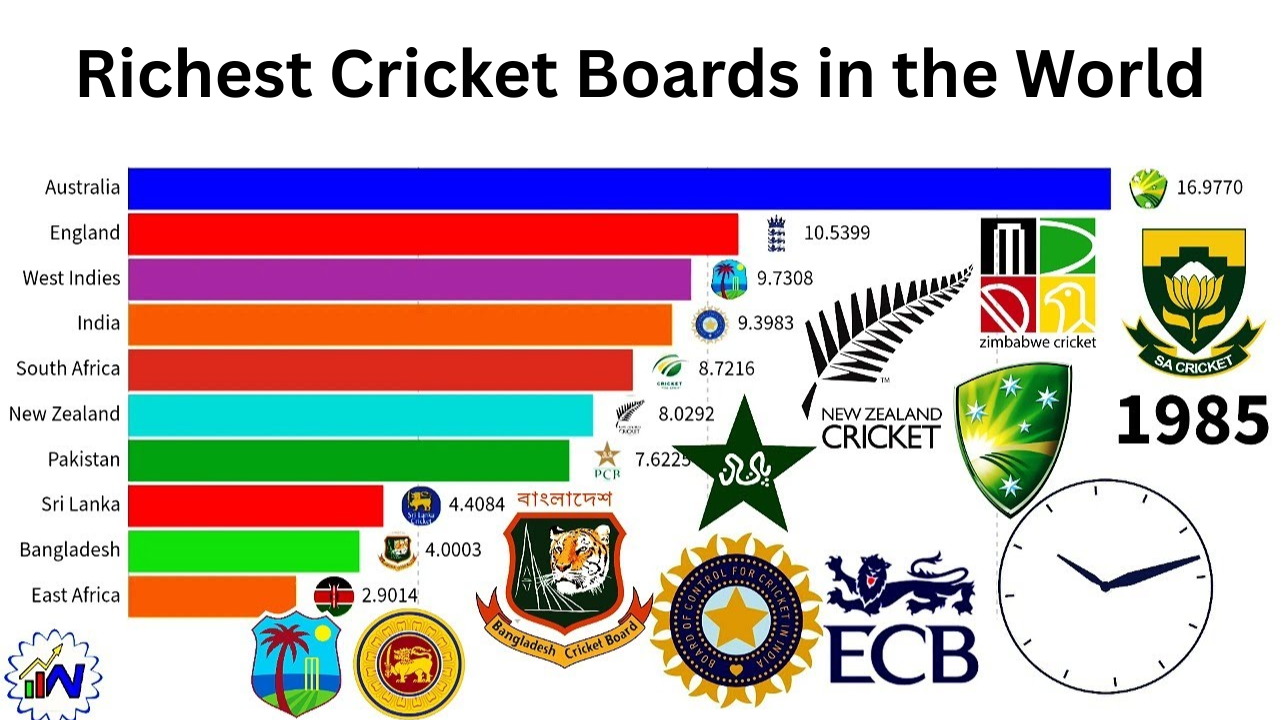
Cricket today is much more than a sport; it has become a multi-billion-dollar entertainment challenge fueled by broadcasting rights, franchise leagues, sponsorship ecosystems, streaming wars, and engaged global fandom. Controlling the most valuable asset in cricket, international and domestic cricket content, national cricket boards are at the heart of this financial empire.
By 2026, the financial chasm between the wealthiest cricket boards and their smaller counterparts had become cavernous, driven by runaway IPL success, digital media rights, and worldwide monetisation of cricket. On the other hand, the Board of Control for Cricket in India (BCCI) often treats all boards financially as an undisputed superpower, banking more revenue than most others combined every few years.
This article is a complete ranking of the 2026 richest cricket boards across the globe with total revenue, income, and a comparison between net financial estates.
Overall Revenue Comparison Table (Estimated 2025–2026 Cycle)
| Rank | Cricket Board | Country | Annual Revenue (USD) | Main Income Source | Financial Strength |
| 1 | BCCI | India | $2.5–3.0 Billion | IPL + Media Rights | Extremely High |
| 2 | ECB | England & Wales | $300–350 Million | The Hundred + Broadcast Rights | High |
| 3 | Cricket Australia (CA) | Australia | $250–300 Million | International Tours + Big Bash League | High |
| 4 | PCB | Pakistan | $100–150 Million | ICC Funding + PSL | Moderate |
| 5 | BCB | Bangladesh | $70–100 Million | ICC Revenue + Home Series | Moderate |
| 6 | CSA | South Africa | $90–120 Million | SA20 League + ICC Revenue | Moderate |
| 7 | NZC | New Zealand | $70–90 Million | ICC Funding + Broadcast Deals | Moderate |
| 8 | SLC | Sri Lanka Cricket | $50–80 Million | ICC Revenue + Tours | Low–Moderate |
| 9 | WICB | West Indies Cricket | $40–70 Million | ICC Funding + Franchise Leagues | Low |
| 10 | ZC | Zimbabwe Cricket | $20–40 Million | ICC Assistance | Low |
1. BCCI – Board of Control for Cricket in India (The Financial Giant)
The BCCI is not just the richest cricket board—it is one of the richest sports organisations in the world, surpassing many football federations and leagues.
Revenue Breakdown (2026)
| Source | Estimated Share |
| IPL Media Rights | 55–60% |
| Sponsorships | 15–20% |
| ICC Revenue Share | 10–15% |
| Bilateral Series | 10% |
| Domestic Cricket | 5% |
Why BCCI is No.1
- IPL generates billions in broadcasting deals
- Massive digital streaming rights from platforms like JioCinema-style services
- Global advertising dominance
- India’s huge cricket fanbase (1.4+ billion population)
- High-value international home series (India vs Australia, England, etc.)
Simply put: IPL has turned BCCI into a global sports monopoly.
2. ECB – England & Wales Cricket Board
ECB is the second richest board due to a strong commercial cricket structure and hosting rights of modern tournaments.
Revenue Breakdown
| Source | Share |
| The Hundred League | 30–35% |
| International Matches | 25% |
| Broadcast Rights | 25% |
| Sponsorship | 15% |
Key Strengths
- Home of cricket (Lord’s & historic venues)
- Strong county cricket system
- The Hundred is improving its commercial reach
3. Cricket Australia (CA)
Australia remains one of the most stable cricket economies in the world.
Revenue Sources
| Source | Share |
| Big Bash League (BBL) | 30% |
| International Tours | 40% |
| Sponsorship | 20% |
| ICC Share | 10% |
Why CA is strong
- Consistent global competitiveness
- Ashes series generates huge revenue
- Strong domestic structure
4. Pakistan Cricket Board (PCB)
PCB has grown financially due to PSL but still depends heavily on ICC funding.
Revenue Breakdown
| Source | Share |
| PSL | 40% |
| ICC Revenue | 35% |
| Bilateral Series | 20% |
| Sponsorship | 5% |
Key Challenges
- Security concerns in the past reduced home revenue
- Lower broadcasting value compared to IPL
5. Bangladesh Cricket Board (BCB)
BCB has shown steady growth driven by strong home support and ICC funding.
Also Read: Best Fielder in the World | Most Beautiful Women Cricketer
Revenue Sources
- ICC distribution: major share
- Home series vs India, Australia
- Bangladesh Premier League (BPL)
6. Cricket South Africa (CSA)
South Africa’s revival is largely driven by the SA20 league.
Key Revenue Drivers
- SA20 franchise league
- Strong IPL-linked investors
- ICC revenue support
7–10: Smaller Boards Overview
New Zealand Cricket
- Highly respected but small market
- Depends heavily on ICC funding
Sri Lanka Cricket
- Financial instability but strong cricket heritage
- ICC support is essential
West Indies Cricket
- Talent-rich but financially weak
- Franchise leagues provide survival income
Zimbabwe Cricket
- Heavily dependent on ICC financial assistance
Global Cricket Economy Analysis (2026)
Key Financial Trends
IPL Dominance: Most of the growth in global cricket revenues comes from the IPL, and this uplifts BCCI’s financial muscle directly.
Franchise League Boom
Globally, boards’ revenues are on the upswing with SA20, BBL, PSL, and The Hundred
Digital Streaming Revolution
TV broadcasts are not the highest revenue-generating medium anymore; OTT platforms have taken that crown.
ICC Redistribution Model
It is well known that ICC revenue share has a huge reliance on the smaller boards.
Revenue Distribution Insight
| Category | Global Impact |
| Franchise Leagues | Very High |
| International Cricket | High |
| ICC Revenue Sharing | Medium |
| Domestic Cricket | Low–Medium |
Why BCCI is Financially Unmatched
The gap between BCCI and other boards is massive because:
- IPL alone earns more than many boards combined
- India hosts the most valuable cricket broadcasting market
- Sponsorship demand is unmatched globally
- Stadium attendance and digital reach are highest in cricket
Conclusions
However, this model of the world cricket economy 2026 paints an astonishingly clear financial hierarchy between international cricket boards, against which one board stands head and shoulders above all others, the Board of Control for Cricket in India (BCCI). The BCCI has converted cricket into one of the most lucrative sports businesses in the world, boosted by astronomical broadcasting rights primarily from the Indian Premier League (IPL) and a fast-growing digital audience. It brings in more revenue than the rest of the world’s cricket put together, evidencing India’s unrivalled drawing power.
The BCCI is the richest board in the world, and at least two more boards – England, and to some extent Australia as well- are also relatively financially stronger thanks to proper domestic leagues like The Hundred or Big Bash League, along with constant international fixtures. Nevertheless, the disparity from top of the pile to mid-level boards such as PCB, BCB and CSA is still wide, with major differences that can come down to market size, value of sponsorships and media rights.
For smaller boards like New Zealand, the West Indies, Sri Lanka and Zimbabwe, financial dependence is high as they rely on ICC revenue distribution to survive, which makes global cricket highly interdependent. As a whole, the 2026 picture reflects an enterprise bent on franchise leagues, digital channels and commercial reach. Globalisation of leagues and more equitable revenue-sharing models offer a way out of financial inequality, and are probably key to cricket’s financial future.
FAQs – the richest cricket board
1. Which is the richest cricket board in 2026?
BCCI is the richest cricket board in 2026 due to IPL and massive broadcasting revenue.
2. Why does BCCI earn more than other boards?
Because of the IPL, huge TV rights deals, and India’s massive cricket fanbase.
3. Who is the second richest cricket board after the BCCI?
The England and Wales Cricket Board (ECB) ranks second due to strong domestic leagues.
4. How do smaller cricket boards survive financially?
They mainly depend on ICC revenue sharing and limited bilateral series income.
5. What is the biggest source of cricket board revenue globally?
Franchise leagues like IPL and media broadcasting rights generate the highest income.
Read More: Top 10 Tallest Cricketer in the World | How Many Sessions in Test Cricket



Leave a Reply